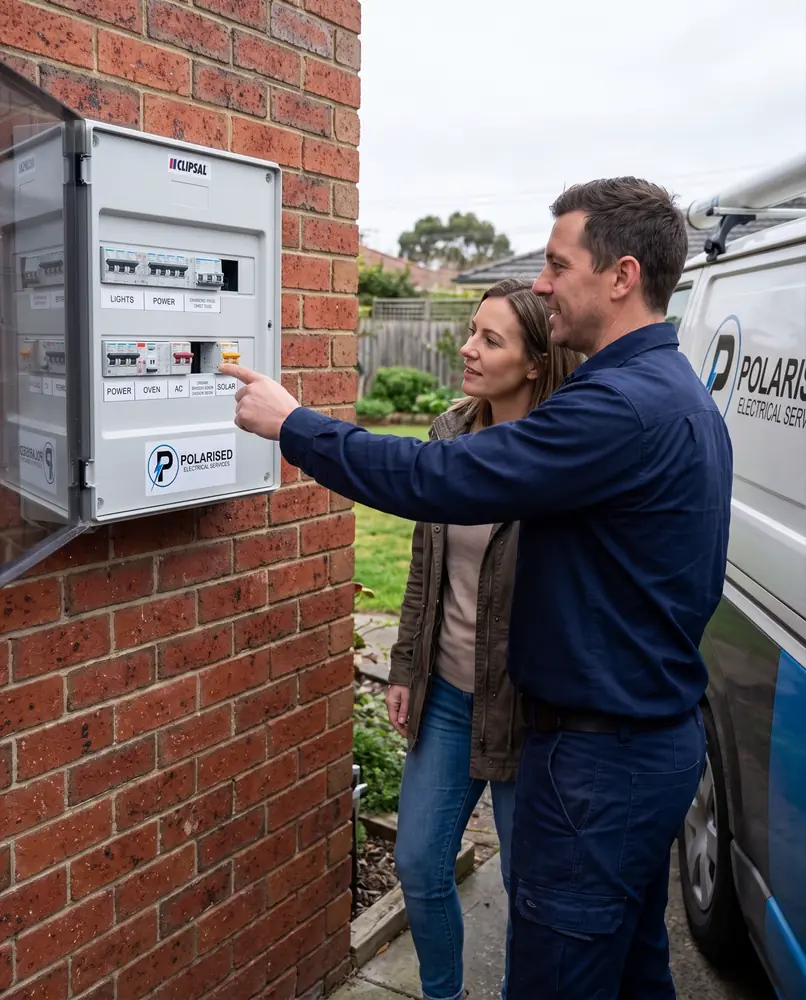
Canterbury sits at about 2600 people per square kilometre, standard detached housing, which is the easiest case for going all-electric: roof space, side access and a board with room to grow. Sitting at about 70 metres, Canterbury has homes where the whole conversion is straightforward given a capable board.
Canterbury is around 10 kilometres out in Boroondara. Older stock means more preparation and a better result when it is done. Boroondara covers Canterbury. We check the overlay before designing anything that goes on a street-facing wall or roof plane.
We treat Canterbury, Balwyn and Camberwell as one working area rather than three separate postcodes. For scale, the 2021 census counted 7800 people in Canterbury, across about 3 square kilometres of Boroondara, postcode 3126.
For what it is worth on site: The first subdivision in the area came in 1885, when Michael Logan created the 'Claremont Park Estate' within the area of Canterbury Road, Bryson Street, Prospect Hill Road and Logan Street. Build era predicts the board, the mains and the insulation, and all three shape the order the work should be done in. Canterbury sits within a group of suburbs we are in constantly: Balwyn, Camberwell, Hawthorn East and Kew East.
Our workshop is in Boronia, 18.7 kilometres west of Canterbury. That proximity is the whole reason we can hold a fixed quote rather than pricing in the unknown. For context on the older parts of the suburb: In 1900 Snowden's estate was subdivided and sold off to form what is now Monomeath Avenue and residents such as notable architect Percey Kernot and prominent citizen George Coghill moved in.
There is more to the local history than that: == History ==
The railway station is in many ways responsible for the suburb's existence: before the opening of the railway to the City in 1882, the area was a semi-rural area.